NATURAL RADIO SIGNALS
Natural radio signals in the ELF (Extremely Low Frequency, 3 Hz – 3 kHz) and VLF (Very Low Frequency, 3 kHz – 30 kHz) bands are electromagnetic emissions generated by geophysical and meteorological phenomena. Since these frequencies overlap with the human audible spectrum, they can be heard directly by converting the electromagnetic signal into audio without complex demodulation.
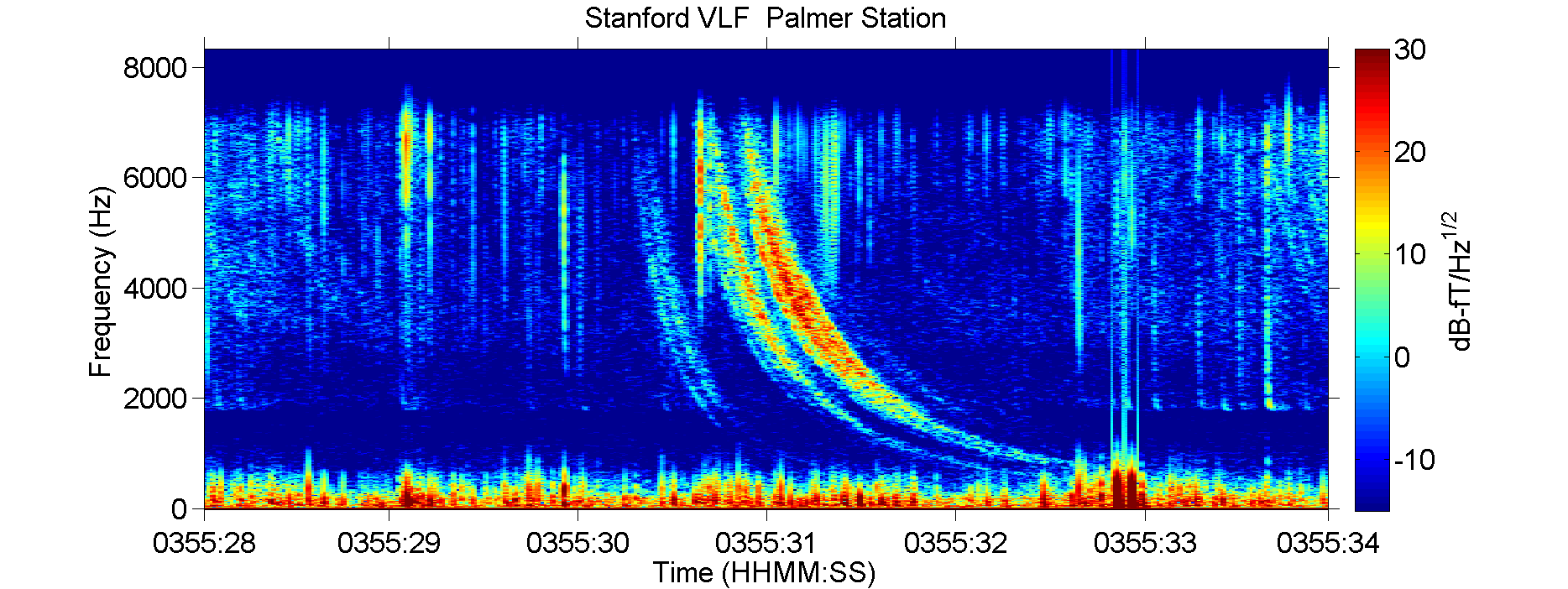
Spectrogram of VLF band
Main Types of Natural Signals
The most common signals are produced by lightning strikes and interactions between solar wind and Earth’s magnetosphere:
Sferics (Atmospherics)
Broadband pulses from lightning discharges. They sound like pops or crackles, similar to a Geiger counter.Tweeks
These occur when a lightning signal travels long distances within the "waveguide" between the Earth's surface and the ionosphere. They have a metallic "ping" sound.Whistlers
Caused by lightning signals traveling along Earth’s magnetic field lines to the opposite hemisphere and back. Due to dispersion, high frequencies arrive before low ones, creating a descending whistle.
Chorus (Down Chorus)
Emissions generated by solar wind particles interacting with the magnetosphere. They sound like birds chirping or a biological cacophony, often heard near dawn.Hiss
A continuous white noise or rushing sound, similar to steam escaping a valve, often associated with auroral activity.Schumann Resonances
Spectral peaks in the ELF band (the primary one at roughly 7.8 Hz) caused by global lightning activity resonating within the Earth-ionosphere cavity.How to Listen
Receiving these signals is relatively simple because the Earth itself acts as a natural antenna for these kilometric wavelengths:
Equipment
A simple whip antenna or a long wire connected to an audio preamplifier and then to a PC’s audio input.Software
Programs like Spectrum Lab or Spectran allow you to visualize the signals' spectrograms in real-time.Location
It is crucial to get away from populated areas to avoid the power grid "hum" (50/60 Hz), which completely overwhelms ELF/VLF bands in urban environments.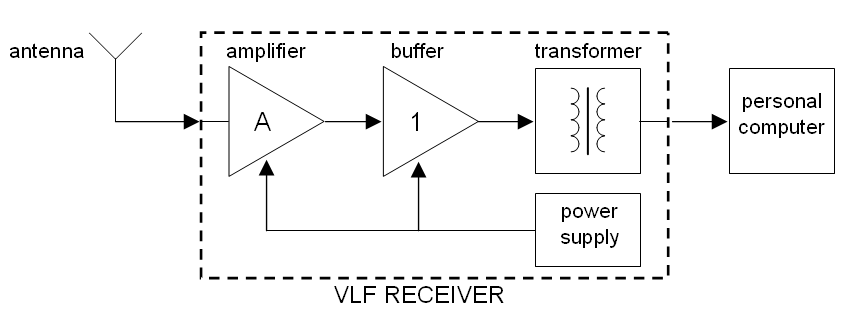
Block diagram of a VLF receiver
(((( 📡 IZ0GIF 📡 ))))