AURORAL "CHORUS"
The Chorus (often called the "Dawn Chorus" because it is most frequent in the morning) is one of the most musical and complex sounds in the natural radio spectrum. Unlike Whistlers, which come from lightning on Earth, the Chorus is born in outer space. Here is the step-by-step physics of how the sun "sings":
The Solar Wind Trigger
The process starts with the Sun. It constantly emits the Solar Wind, a stream of charged particles (electrons and protons). During solar flares or Coronal Mass Ejections (CMEs), this wind becomes a high-speed blast that slams into Earth’s magnetic shield.

Amazing northern lights
The Magnetospheric "Trap"
Earth is surrounded by a magnetic "bubble" called the Magnetosphere. Some of the solar electrons get trapped in the Van Allen radiation belts (specifically the outer belt). These electrons spiral along the Earth's magnetic field lines at incredible speeds.
Wave-Particle Interaction (The "Chorus" Mechanism)
The magic happens in a region called the Equatorial Plane (above the Earth's equator).
• As the trapped electrons spiral, they interact with existing low-frequency electromagnetic waves.
• Through a process called Cyclotron Resonance, the electrons "clump" together and transfer their kinetic energy into the electromagnetic wave.
• This acts like a natural laser or amplifier: a tiny radio noise is suddenly boosted into a powerful, rising tone.
Why it sounds like "Chirping"
The "chirp" or "whistle" occurs because the interaction is dynamic. As the wave grows, it changes the motion of the electrons,
which in turn changes the frequency of the wave.
• Rising Tones: Most Chorus signals start low and sweep upward in frequency (increases over time).
• Falling Tones: Occasionally, they sweep downward, depending on the plasma density in that part of space.
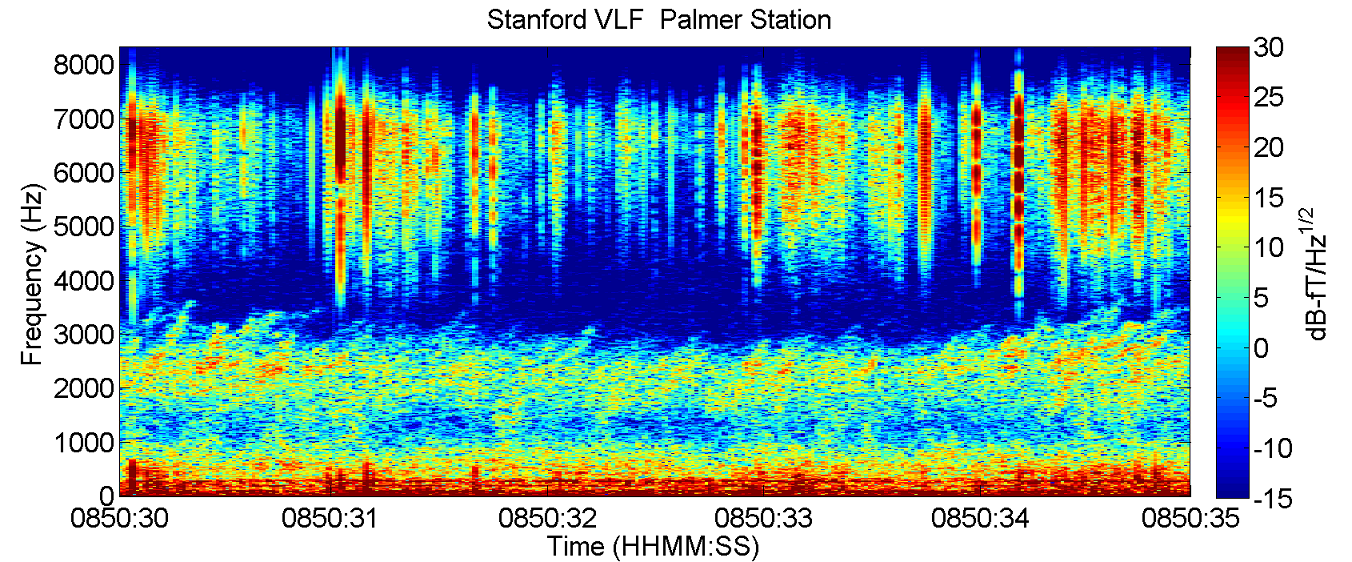
Spectrogram of aurora choruses
The "Dawn" Connection
We call it the Dawn Chorus because the Earth's magnetosphere is "compressed" on the side facing the Sun. The conditions for this energy transfer are most stable on the morning side of the Earth (between midnight and 10:00 AM local time).Scientific Importance
Scientists study the Chorus because these waves are "electron killers" or "electron makers." They can:
• Accelerate electrons to "killer" speeds that can damage GPS and communication satellites.
• Scatter electrons down into the atmosphere, contributing to the Aurora Borealis (Northern Lights).
(((( 📡 IZ0GIF 📡 ))))